Vertical farming is no longer a theoretical promise. It’s real, and it’s growing—literally and commercially. But as with any rapidly evolving industry, the difference between surviving and scaling lies in how you design your system.
Reinier Donkersloot shares 7 valuable lessons that he learned during the past decade being active as an indoor farming consultant.
At Airlux Technologies, we’ve spent more than 17 years helping growers maximize results through advanced climate and LED lighting solutions. Over that time, I’ve seen dozens of vertical farms succeed—and many struggle—based on how they approached one crucial phase: the design.
Donkersloot shares some of the key lessons he has learned about farm design, operational strategy, and where many projects go wrong. These insights are not from theory, but from years in the trenches with growers, investors, and engineers.

About Reinier Donkersloot:
Reinier Donkersloot is a seasoned expert in vertical farming and controlled environment agriculture (CEA), with over 10 years of experience in horticultural technology and business development. He currently serves as Business Development Manager at Airlux Technologies.
1. Don’t design until you define successecessity
One of the most common mistakes according to Donkersloot is that farms are rushing into design without clearly defining their operational goals. Operational goals should be formed around questions like do you want the highest-quality product on the market? Or do you focus on the lowest possible production cost? Or maybe the highest output per square meter?
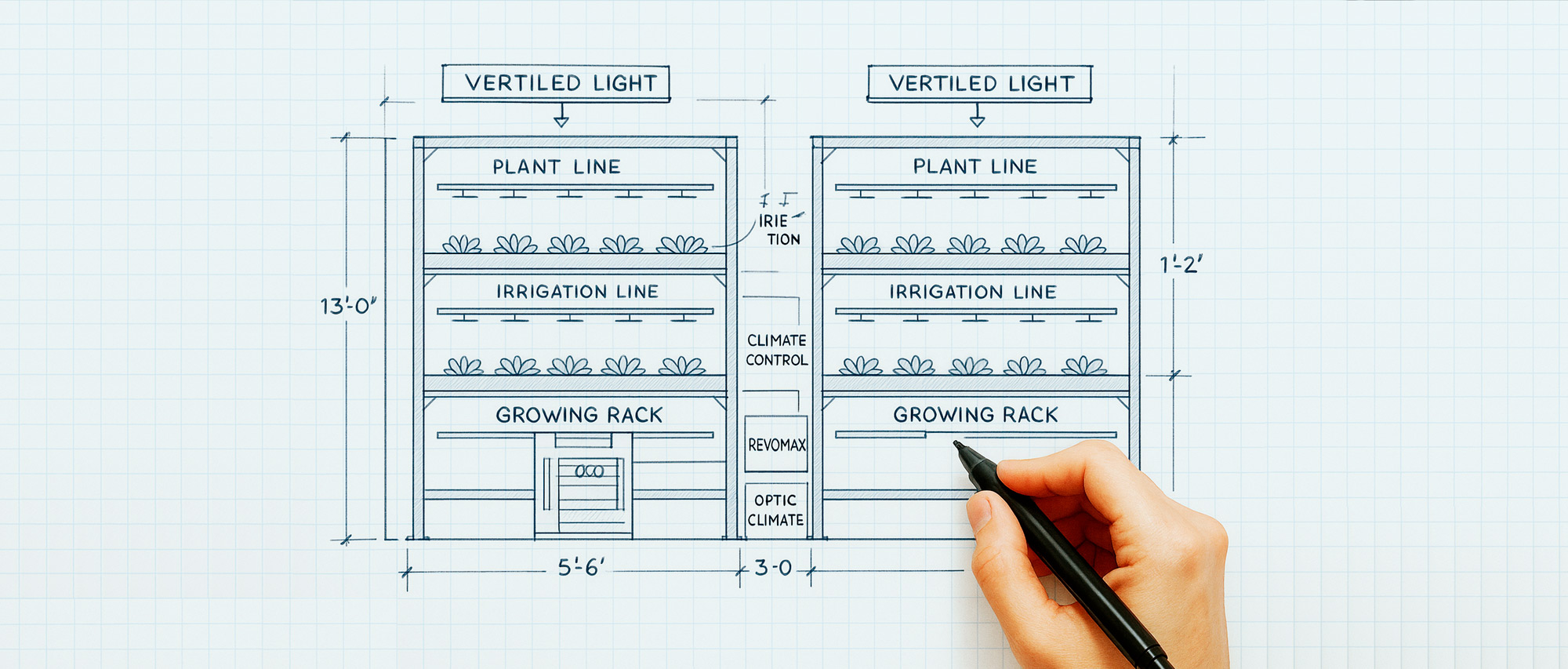 Define your goals before you start designing.
Each goal leads to a radically different farm with a very different set of design choices, from automation to airflow. And goals don’t stop at product metrics. Your market positioning, supply chain integration, local energy and labor costs – all of these should be part of your strategy before you sketch the first layout. Design follows intent, not the other way around.
2. Build around the engine: light, air, water
The three elements of plant growth – light, air, and water – form the beating heart of any vertical farm. These systems (LED lighting, climate control, and fertigation) deserve in Donkersloot’s opinion disproportionate attention in both design and budget.
This engine doesn’t just support plant growth. It defines your efficiency, your cost structure, and your ability to scale. The lighting system can be corrected, but a bad climate design will ruin your farming results.
For example, if airflow isn’t optimized, humidity can stall growth – or worse, create mold and disease. If lighting isn’t tunable, crops can underperform. If nutrient delivery isn’t stable, consistency disappears. The lesson: get the engine right, and the rest follows.
3. Smarter control through AI and data
Vertical farms shouldn’t be built to impress, they should be built to perform. “Too often, we see projects over-investing in complex systems with marginal gains, while neglecting foundational efficiencies. You might be better off choosing a solution which has already
been developed for another industry—like choosing a solid Skoda over a fancy Audi with the same engine.”
Stripping the design back to what’s truly essential can unlock enormous savings. Donkersloot believes that €1.000 per square meter of cultivation space should be the benchmark. “With thoughtful design and smart component choices, it’s absolutely attainable.” Performance isn’t about cutting corners, it’s about cutting out the unnecessary.
4. Automate with intention, not ego
Automation is a hot topic—but also one of the most misunderstood. Some see it as the ultimate solution. Others resist it out of cost fears. The truth lies in between.
More machines mean fewer human errors. But don’t automate everything blindly—balance labor, energy, and risk.
Automation should be guided by your local conditions. If your labor costs are high, automation will often pay for itself quickly. If hygiene is critical (and it usually is), reducing human interaction can be essential.
But full automation isn’t always the answer. Smart farms automate the right processes—like seeding, harvesting, packaging—and scale those systems as needed.
5. Scale up with eyes open
Designing a small-scale proof of concept is very different from building a commercial facility. Many farms underestimate the challenge of scaling.
In a small farm, you can touch every leaf. In a large farm, you only see your crop after 30 days. You need systems that give you control at scale.
When scaling, you lose physical visibility. So your systems need to provide digital oversight—monitoring, alerting, tracking crop progress across the lifecycle. You also need clear feedback loops and contingency plans for failures.
Scaling too fast without robust control systems is a recipe for operational chaos.
6. Focus on margin, not just CapEx
CapEx often dominates early-stage conversations. But if you’re serious about building a long-term business, operational performance is what really matters.
A vertical farmer needs to focus on a healthy gross margin instead of CapEx to survive long term.
Energy and labor are the two largest ongoing costs. Designing for energy efficiency—and locking in predictable pricing—isn’t just smart. It’s essential.
7. Be a grower or a builder—not both
This may be one of the most important lessons of all: know your core. And stick to it.
Stick to your core. Be a farm. Or be a tech provider. But don’t try to be both.
We’ve seen farms build great internal systems—and then try to sell them to others. The problem is, the demands of running a farm and developing technology are completely different. Without dedicated focus, both sides can suffer.
Our strongest partnerships are with farms who focus on growing, and partner with experts on the tech. That’s where we add value—by bringing deep expertise in lighting and climate systems, so growers can do what they do best.
 We believe in a co-development approach
Partners, not providers
At Airlux, we believe vertical farming isn’t about procurement. It’s about partnership.
Our work with Growy is a perfect example. Together, we co-developed a system that aligned with their cultivation strategy, their energy model, and their long-term goals. From water-cooled LEDs to integrated climate control, every component was fine-tuned to work in harmony.
Vertical farmers are still farmers. We’re not just producers. Our strength lies in growing strong, healthy plants.
We’re not just thinking about your launch day. We’re thinking about year three. Year ten. About scaling with you—not just shipping to you.
Looking forward
The vertical farming sector is entering its next phase. The early excitement is giving way to smarter, more strategic development. Efficiency is no longer optional. It’s the new baseline.
Whether you’re planning your first commercial site or scaling internationally, your success starts with good design—and the right people around the table from day one.
As a team, we’re here to think with you, build with you, and help you reach optimal performance from seed to system.
Let’s design farms that grow more than plants. Let’s design farms that grow results.